Global Health
Paragraphs

We examine how variation in local economic conditions has shaped the AIDS epidemic in Africa. Using data from over 200,000 individuals across 19 countries, we match biomarker data on individuals' serostatus to information on local rainfall shocks, a large source of income variation for rural households. We estimate infection rates in HIV-endemic rural areas increase by 11% for every recent drought, an effect that is statistically and economically significant. Income shocks explain up to 20% of variation in HIV prevalence across African countries, suggesting existing approaches to HIV prevention could be bolstered by helping households manage income risk better.

All Publications button
1
Publication Type
Journal Articles
Publication Date
Journal Publisher
The Economic Journal
Authors
Marshall Burke
News Type
News
Date
Paragraphs

Bad weather in sub-Saharan Africa increases the spread of HIV, according to a study published in the June 2015 issue of the Economic Journal, co-authored by Stanford professor and FSE fellow Marshall Burke.

When the rains fail, farmers in rural areas often see their incomes fall dramatically and will try to make up for it however they can, including through sex work. Analysing data on more than 200,000 individuals across 19 African countries, the research team finds that by changing sexual behaviour, a year of very low rainfall can increase local infection rates by more than 10%.

The results have important policy implications for fighting the spread of the epidemic, as co-author Erick Gong of Middlebury College notes:

‘Existing approaches to stopping the spread of HIV – such as promoting condom use and the use of anti-retrovirals – remain critically important. But our results suggest that other policy approaches could be very useful too – in particular, approaches that provide safety nets to rural households when the weather turns bad.’

Policies and investments seemingly unrelated to HIV – such as the promotion of rural insurance or household savings schemes, or the development of drought-tolerant crops – might have surprising benefits in slowing the HIV epidemic. Co-author Kelly Jones of the International Food Policy Research Institute says:

‘The HIV/AIDS epidemic remains one of the world’s greatest health challenges, with over a million new infections per year in Africa alone. Our results expand the menu of options for addressing the epidemic, and highlight some surprising options that are not at the forefront of people’s minds.’

The research sheds valuable light on why HIV continues to spread in Africa. Previous studies have documented in limited settings that poor women often alter their sexual behaviour in response to an income shortfall. But until now, there has been little evidence that this response is big enough to affect the trajectory of the HIV epidemic.

To fill this gap, the researchers combined data on the HIV status of thousands of people across sub-Saharan Africa with data on the recent rainfall history in each individual’s location.

Because years of low rainfall can lead to much lower incomes in these locations, particularly in rural areas where people depend more heavily on agriculture for their livelihoods, variation in rainfall provides a way to study how changes in local economic conditions affect infection rates. Co-author Marshall Burke comments:

‘We were surprised by how strong the relationship is between recent rainfall fluctuations and local infection rates. As expected, the relationship is much stronger in rural areas, and particularly for women who report working in agriculture. These are the people who really suffer when the rains fail, and who are forced to turn to more desperate measures to make ends meet.’

Notes for editors: ‘Income Shocks and HIV in Africa’ by Marshall Burke, Erick Gong and Kelly Jones is published in the June 2015 issue of the Economic Journal.

Marshall Burke is an assistant professor of Earth System Science at Stanford University. Erick Gong is an assistant professor of economics at Middlebury College. Kelly Jones is a research fellow at the International Food Policy Research Institute (IFPRI).

For further information: contact Marshall Burke on +1-650-736-8571 (email: mburke@stanford.edu); Erick Gong on +1-802-443-5553 (email: egong@middlebury.edu); Kelly Jones on +1-202-862-4641 (email: k.jones@cgiar.org); or Romesh Vaitilingam on +44-7768-661095 (email: romesh@vaitilingam.com; Twitter: @econromesh).

Hero Image
75148497 50e081cd5b b Jon Rawlinson/flickr
All News button
1
Authors
News Type
News
Date
Paragraphs

In a recent speech, Stanford professor Rosamond Naylor examined the wide range of challenges contributing to global food insecurity, which Naylor defined as a lack of plentiful, nutritious and affordable food. Naylor's lecture, titled "Feeding the World in the 21st Century," was part of the quarterly Earth Matters series sponsored by Stanford Continuing Studies and the Stanford School of Earth Sciences. Naylor, a professor of Environmental Earth System Science and director of the Center on Food Security and the Environment at Stanford, is also a professor (by courtesy) of Economics, and the William Wrigley Senior Fellow at the Freeman Spogli Institute for International Studies and the Stanford Woods Institute for the Environment.

"One billion people go to bed day in and day out with chronic hunger," said Naylor. The problem of food insecurity, she explained, goes far beyond food supply. "We produce enough calories, just with cereal crops alone, to feed everyone on the planet," she said. Rather, food insecurity arises from a complex and interactive set of factors including poverty, malnutrition, disease, conflict, poor governance and volatile prices. Food supply depends on limited natural resources including water and energy, and food accessibility depends on government policies about land rights, biofuels, and food subsidies. Often, said Naylor, food policies in one country can impact food security in other parts of the world. Solutions to global hunger must account for this complexity, and for the "evolving" nature of food security.

As an example of this evolution, Naylor pointed to the success of China and India in reducing hunger rates from 70 percent to 15 percent within a single generation. Economic growth was key, as was the "Green Revolution," a series of advances in plant breeding, irrigation and agricultural technology that led to a doubling of global cereal crop production between 1970 and 2010. But Naylor warned that the success of the Green Revolution can lead to complacency about present-day food security challenges. China, for example, sharply reduced hunger as it underwent rapid economic growth, but now faces what Naylor described as a "second food security challenge" of micronutrient deficiency. Anemia, which is caused by a lack of dietary iron and which Naylor said is common in many rural areas of China, can permanently damage children's cognitive development and school performance, and eventually impede a country’s economic growth.

Hunger knows no boundaries

Although hunger is more prevalent in the developing world, food insecurity knows no geographic boundaries, said Naylor. Every country, including wealthy economies like the United States, struggles with problems of food availability, access, and nutrition. "Rather than think of this as 'their problem' that we don't need to deal with, really it's our problem too," Naylor said.

She pointed out that one in five children in the United States is chronically hungry, and 50 million Americans receive government food assistance. Many more millions go to soup kitchens every night, she added. "We are in a precarious position with our own food security, with big implications for public health and educational attainment," Naylor said. A major paradox of the United States' food security challenge is that hunger increasingly coexists with obesity. For the poorest Americans, cheap food offers abundant calories but low nutritional value. To improve the health and food security of millions of Americans, "linking policy in a way that can enhance the incomes of the poorest is really important, and it's the hard part,” she said.” It's not easy to fix the inequality issue."

Success stories

When asked whether there were any "easy" decisions that the global community can agree to, Naylor responded, "What we need to do for a lot of these issues is pretty clear, but how we get after it is not always agreed upon." She added, "But I think we've seen quite a few success stories," including the growing research on climate resilient crops, new scientific tools such as plant genetics, improved modeling techniques for water and irrigation systems, and better knowledge about how to use fertilizer more efficiently. She also said that the growing body of agriculture-focused climate research was encouraging, and that Stanford is a leader on this front.

Naylor is the editor and co-author of The Evolving Sphere of Food Security, a new book from Oxford University Press. The book features a team of 19 faculty authors from 5 Stanford schools including Earth science, economics, law, engineering, medicine, political science, international relations, and biology. The all-Stanford lineup was intentional, Naylor said, because the university is committed to interdisciplinary research that addresses complex global issues like food security, and because "agriculture is incredibly dominated by policy, and Stanford has a long history of dealing with some of these policy elements. This is the glue that enables us to answer really challenging questions." 


Hero Image
img 0529
All News button
1

Human exposure to lead in the environment causes irreversible impairment of intellectual function. In Bangladesh, where some rural residents have unexpectedly high levels of lead in their blood, the source is proving difficult to pinpoint. This project will evaluate the severity of lead poisoning in rural Bangladesh and identify the pathway of exposure to help develop focused prevention strategies.

Authors
News Type
News
Date
Paragraphs

Outside of China, the world now has more food insecure and nutrient deficient people than it had a decade ago, and the prevalence of obesity-related diabetes, high blood pressure and cardio-vascular diseases is increasing at very rapid rates. Expanded food production has done little to address the fact that between one-third and one-half of all deaths in children under five in developing countries are still related to malnutrition.

“With only three years away from the Millennium Development Goals deadline, this is a terrible track record,” said food and nutrition policy expert Per Pinstrup-Andersen at FSE's Global Food Policy and Food Security Symposium Series last week.  

Pinstrup-Andersen, the only economist to win the World Food Prize (the ultimate award in the food security field), has dedicated his career to understanding the linkages between food, nutrition, and agriculture. What is driving persistent food insecurity and malnutrition in a food abundant world?

Poor food supply management is part of the problem. According to the United Nations Food and Agricultural Organization (FAO), 20-30% of food produced globally is lost every year. That’s enough to feed an additional 3-3.5 billion people.

Jatropha in Africa. Photo credit: Ton Rulkens/flickr.

Biofuels production, such as jatropha in Africa, now competes with food for land, and climate change is already negatively impacting crop yields in regions straddling the equator—with major implications for food supply.

For low-income consumers in both the U.S. and developing countries increasing and more volatile food prices, such as those seen in 2007, are also driving food insecurity. Poor consumers respond by purchasing cheaper, less nutrient food, and less of it.

Nutritional value chain

Consensus is developing—at least rhetorically—among national policymakers and international organizations that investments in agricultural development must be accelerated. Members of the G8 and G20 have committed $20 billion in international economic support for such investments and some developing countries such as Ethiopia and Ghana are planning large new investments.

While most of these recent initiatives focus on expanded food supplies, there is an increasing understanding that merely making more food available will not assure better food security, nutrition, and health at the household and individual levels.

“It matters for health and nutrition how increasing food supplies are brought about and of what it consists,” said Pinstrup-Andersen. “We need to turn the food supply chain into a nutritional value chain.”

Diet diversity is incredibly important for good nutrition. Agricultural researchers and food production companies need to look at a number of different commodities, not just the major food staples, said Pinstrup-Andersen.

“The Green Revolution successfully increased the production of corn, rice, and wheat, increasing incomes for farmers, and lowering prices for consumers, but now it is time to invest in fruits, vegetables and biofortification to deal with micronutrient deficiency,” said Pintrup-Andersen.

Biofortification, the breeding of crops to increase their nutritional value, offers tremendous opportunity for dealing with malnutrition in the developing world, but is not widely available.

This is particularly important for areas in sub-Saharan Africa where between one and three and one and four people are short in calories, protein, and micronutrients. Obesity is actually going up in these countries with the introduction of cheap, processed, energy-dense foods (those high in sugar and fat) contributing to the diabetes epidemic.

Pathways to better health

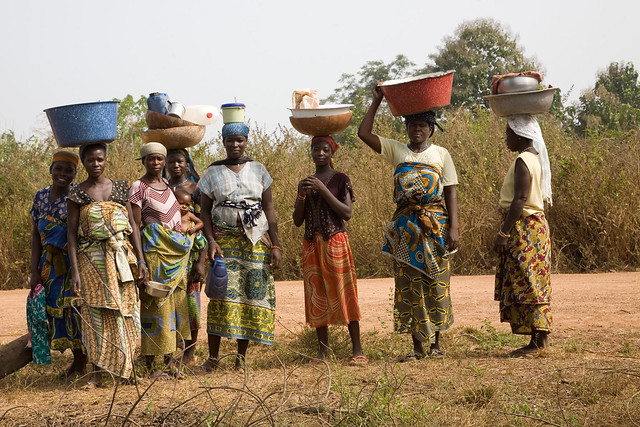
Women hauling water to their gardens in Benin.

The path to better health and nutrition must look beyond the availability of food at affordable prices, clean water, and good sanitation, and consider behavioral factors such as time constraints for women in low-income households.

“Field studies have shown time and time again that one of the main factors preventing women from providing themselves and their families with good nutrition is time,” explained Pinstrup-Andersen.

He told the story of a woman in Bolivia too burdened with farm and household responsibilities to take the time to breastfeed her six-month old daughter. Enhancing productivity in activities traditionally undertaken by women could be a key intervention to improving good health and nutrition at the household level.

Access is another issue. A household may be considered food secure, in that sufficient food may be available, but food may not be equally allocated in the household.

“If we focus on the most limiting constraint we can be successful,” said Pinstrup-Anderen. “But we must tailor our response to each case.”

For sub-Saharan Africa, this includes investments in rural infrastructure, roads, irrigation systems, micronutrient fertilizer, climate adaptation strategies, and other barriers holding back small farmers.

Fortunately, there has been a renewed attention to the importance of guiding food system activities towards improved health and nutrition. The Global Agriculture and Food Security Program (GAFSP), which facilitates the distribution of some of the G8 and G20 $20 billion commitments, prescribes that country proposals for funding of agricultural development projects must show a clear pathway from the proposed agricultural change to human nutrition.

“But it’s not going to be easy to implement good policies,” warned Pinstrup-Andersen. “There are few incentives in government for multidisciplinary problem solving. The economy is set up around silos and people are loyal to their silos. Agricultural and health sectors are largely disconnected in their priorities, policy, and analysis."

Incentives must change to encourage working across ministries and disciplines to identify the most important health and nutrition-related drivers of food systems, impact pathways, and policy and program interventions to find win-wins for positive health and nutrition.

Hero Image
carrots celebration logo
All News button
1
News Type
Q&As
Date
Paragraphs

President Obama and Mitt Romney meet for their third debate to discuss foreign policy on Monday, when moderator Bob Schieffer is sure to ask them about last month's terrorist attack in Libya and the nuclear capabilities of Iran.

In anticipation of the final match between the presidential candidates, researchers from five centers at Stanford’s Freeman Spogli Institute for International Studies ask the additional questions they want answered and explain what voters should keep in mind.


What can we learn from the Arab Spring about how to balance our values and our interests when people in authoritarian regimes rise up to demand freedom?  

What to listen for: First, the candidates should address whether they believe the U.S. has a moral obligation to support other peoples’ aspirations for freedom and democracy. Second, they need to say how we should respond when longtime allies like Egypt’s Hosni Mubarak confront movements for democratic change.

And that leads to more specific questions pertaining to Arab states that the candidates need to answer: What price have we paid in terms of our moral standing in the region by tacitly accepting the savage repression by the monarchy in Bahrain of that country's movement for democracy and human rights?  How much would they risk in terms of our strategic relationship with Bahrain and Saudi Arabia by denouncing and seeking to restrain this repression? What human rights and humanitarian obligations do we have in the Syrian crisis?  And do we have a national interest in taking more concrete steps to assist the Syrian resistance?  On the other hand, how can we assist the resistance in a way that does not empower Islamist extremists or draw us into another regional war?  

Look for how the candidates will wrestle with difficult trade-offs, and whether either will rise above the partisan debate to recognize the enduring bipartisan commitment in the Congress to supporting democratic development abroad.  And watch for some sign of where they stand on the spectrum between “idealism” and “realism” in American foreign policy.  Will they see that pressing Arab states to move in the direction of democracy, and supporting other efforts around the world to build and sustain democracy, is positioning the United States on “the right side of history”?

~Larry Diamond, director of the Center on Democracy, Development, and the Rule of Law


What do you consider to be the greatest threats our country faces, and how would you address them in an environment of profound partisan divisions and tightly constrained budgets? 

What to listen for: History teaches that some of the most effective presidential administrations understand America's external challenges but also recognize the interdependence between America's place in the world and its domestic situation.

Accordingly, Americans should expect their president to be deeply knowledgeable about the United States and its larger global context, but also possessed of the vision and determination to build the country's domestic strength.

The president should understand the threats posed by nuclear proliferation and terrorist organizations. The president should be ready to lead in managing the complex risks Americans face from potential pandemics, global warming, possible cyber attacks on a vulnerable infrastructure, and failing states.

Just as important, the president needs to be capable of leading an often-polarized legislative process and effectively addressing fiscal challenges such as the looming sequestration of budgets for the Department of Defense and other key agencies. The president needs to recognize that America's place in the world is at risk when the vast bulk of middle class students are performing at levels comparable to students in Estonia, Latvia and Bulgaria, and needs to be capable of engaging American citizens fully in addressing these shared domestic and international challenges.

~Mariano-Florentino Cuéllar, co-director of the Center for International Security and Cooperation


Should our government help American farmers cope with climate impacts on food production, and should this assistance be extended to other countries – particularly poor countries – whose food production is also threatened by climate variability and climate change?

What to listen for: Most representatives in Congress would like to eliminate government handouts, and many would also like to turn away from any discussion of climate change. Yet this year, U.S. taxpayers are set to pay up to $20 billion to farmers for crop insurance after extreme drought and heat conditions damaged yields in the Midwest.

With the 2012 farm bill stalled in Congress, the candidates need to be clear about whether they support government subsidized crop insurance for American farmers. They should also articulate their views on climate threats to food production in the U.S. and abroad.

Without a substantial crop insurance program, American farmers will face serious risks of income losses and loan defaults. And without foreign assistance for climate adaptation, the number of people going hungry could well exceed 15 percent of the world's population. 

~Rosamond L. Naylor, director of the Center on Food Security and the Environment


What is your vision for the United States’ future relationship with Europe? 

What to listen for: Between the end of World War II and the end of the Cold War, it was the United States and Europe that ensured world peace. But in recent years, it seems that “Europe” and “European” have become pejoratives in American political discourse. There’s been an uneasiness over whether we’re still friends and whether we still need each other. But of course we do.

Europe and the European Union share with the United States of America the most fundamental values, such as individual freedom, freedom of speech, freedom to live and work where you choose. There’s a shared respect of basic human rights. There are big differences with the Chinese, and big differences with the Russians. When you look around, it’s really the U.S. and Europe together with robust democracies such as Canada and Australia that have the strongest sense of shared values.

So the candidates should talk about what they would do as president to make sure those values are preserved and protected and how they would make the cooperation between the U.S. and Europe more effective and substantive as the world is confronting so many challenges like international terrorism, cyber security threats, human rights abuses, underdevelopment and bad governance.

~Amir Eshel, director of The Europe Center


Historical and territorial issues are bedeviling relations in East Asia, particularly among Japan, China, South Korea, and Southeast Asian countries. What should the United States do to try to reduce tensions and resolve these issues?

What to listen for: Far from easing as time passes, unresolved historical, territorial, and maritime issues in East Asia have worsened over the past few years. There have been naval clashes, major demonstrations, assaults on individuals, economic boycotts, and harsh diplomatic exchanges. If the present trend continues, military clashes – possibly involving American allies – are possible.

All of the issues are rooted in history. Many stem from Imperial Japan’s aggression a century ago, and some derive from China’s more assertive behavior toward its neighbors as it continues its dramatic economic and military growth. But almost all of problems are related in some way or another to decisions that the United States took—or did not take—in its leadership of the postwar settlement with Japan.

The United States’ response to the worsening situation so far has been to declare a strategic “rebalancing” toward East Asia, aimed largely at maintaining its military presence in the region during a time of increasing fiscal constraint at home. Meanwhile, the historic roots of the controversies go unaddressed.

The United States should no longer assume that the regional tensions will ease by themselves and rely on its military presence to manage the situation. It should conduct a major policy review, aimed at using its influence creatively and to the maximum to resolve the historical issues that threaten peace in the present day.

~David Straub, associate director of the Korea Studies Program at the Walter H. Shorentein Asia-Pacific Research Center


Compiled by Adam Gorlick.

Hero Image
debatepic
President Obama and Mitt Romney speak during the second presidential debate on Oct. 16, 2012. Their third and final debate will focus on foreign policy.
Reuters
All News button
1

More than two-thirds of the population in Africa must leave their home to fetch water for drinking and domestic use. It is estimated that some 40 billion hours of labor each year are spent hauling water, a responsibility often borne by women and children. Cutting the walking time to a water source by just 15 minutes can reduce under-five mortality of children by 11 percent, and slash the prevalence of nutrition-depleting diarrhea by 41 percent.

Subscribe to Global Health