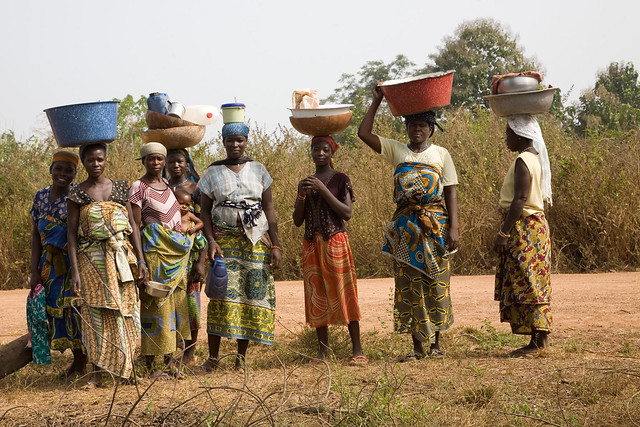
Promotion of smallholder irrigation is cited as a strategy for enhancing income generation and food security for sub-Saharan Africa’s poor farmers, but what makes this technology a successful poverty alleviation tool? In the short run, the technology should pave the way for increased consumption, asset accumulation, and reduced persistent poverty among users. Over the longer run, it should lead to institutional feedbacks that support sustained economic development and nutritional improvements. Our conceptual model and review of case studies reveal the importance of three sub-components of irrigation technology—access, distribution, and use—and the ways in which the design of the technology itself can either bridge, or succumb to, institutional gaps. These critical features are illustrated in an experimental evaluation of a solar-powered drip irrigation project in rural northern Benin, which provides a controlled study of technology impacts in the Sudano-Sahel. The combined evidence highlights the technical and institutional requirements for project success and points to two important areas of research in the scale-up of any small-scale irrigation strategy: the risk behavior of water users, and the evolution of institutions that either support or obstruct project replication over space and time.
Indonesia is currently the world’s top palm oil producer. Since the 1980s total land area planted to palm oil has increased by over 2,100 percent growing to 4.6 million hectares – the equivalent of six Yosemite National Parks. Plantation growth has predominately occurred on deforested native rainforest with major implications for global carbon emissions and biodiversity.
World leaders are focused on agricultural supply data, insurance schemes and speculation as they try to quell volatility in global food markets. They should also turn their attention to perhaps the leading cause of price instability: U.S. ethanol policy.
Five years ago, few if any food or energy experts predicted that 40 percent of the U.S. corn crop in 2011 would be devoted to ethanol production. Nor did they imagine: that corn prices would reach all-time highs at $8 per bushel ($275 per metric ton); that July futures prices for corn in Chicago would exceed those for wheat; that the United States would be exporting ethanol to Brazil; or that an Iowa Senator would co-sponsor a bill to reduce corn-based subsidies just prior to the Iowa Caucuses for the 2012 primary season. What has caused these extraordinary circumstances? And what are the economic, political and food-security implications of a revolution in demand that has caught both economists and political leaders unaware?
Policies promoting ethanol and biodiesel production and use in the U.S., Europe, and other parts of the world since the mid-2000s have had profound—and largely unintended—consequences on global food prices, agricultural land values, land acquisition, and food security in developing countries. They have also created regional opportunities in the form of agricultural investments, crop yield growth, and booming farm economies. Rising incomes in emerging economies are generating increased demand for transportation fuels, thus stimulating further growth of the global biofuel industry. This seminar will explore the politics, economics, and global food security implications of the expanding biofuel sector. Several policy questions will be raised, including the role of biofuel mandates on food prices, the role of trade policies for stabilizing food prices in an era of increasingly tight demand, and the role of land policies and institutions for feedstock production and income distribution in the developing world.
Siwa Msangi, Senior Research Fellow in the Environment and Production Technology Division at the International Food Policy Research Institute (IFPRI) will provide commentary. Msangi's work focuses on the major socio-economic and bio-physical drivers affecting agricultural production and trade, and their impacts on nutrition, poverty and the environment. Dr. Msangi manages a research portfolio that includes the economic and environmental implications of biofuels, and has coordinated the project Biofuels and the Poor in partnership with FSE.
Senior Fellow, Emerita, Stanford Woods Institute and Freeman Spogli Institute for International Studies,
William Wrigely Professor, Emerita, Department of Environmental Social Sciences
Roz_low_res_9_11_cropped.jpg
PhD
Rosamond (Roz) Naylor is the William Wrigley Professor, Emerita, of Global Environmental Policy in the Doerr School of Sustainability; and founding Director of the Center on Food Security and the Environment (FSE) at Stanford University. Her research focuses on policies and practices to improve global food security and protect the environment on land and at sea. She has been involved in numerous field-level research projects around the world with her students and has published widely on issues related to global food systems, food policy, and aquaculture. She is the co-chair of The Blue Food Assessment, an international initiative aimed at providing a comprehensive scientific evaluation of the sustainability, nutrition, equity, and justice dimensions of aquatic foods cultured and captured in freshwater and marine environments within the global food system. She is a Member of the National Academy of Sciences, a Fellow of the American Association for the Advancement of Science (AAAS), Fellow of the Ecological Society of America (ESA), a Pew Marine Fellow, and a Leopold Leadership Fellow. She is also the Chair of the Board of Directors for the Aspen Global Change Institute and a member of the Scientific Advisory Committee for Oceana. At Stanford, she teaches courses on The World Food Economy, Human Society and Environmental Change, and Food and Security.
Sugar and ethanol production are key components of Brazil's rural development and energy strategies, yet in recent years sugar production has been widely criticized for its environmental and labor practices. This study examines the relationship between rural development and sugarcane, ethanol, and cattle production in the state of São Paulo. Our results suggest that the value added components of sugarcane production, which include sugar refining and ethanol production, may have a strong positive affect on local human development in comparison to primary agricultural production activities and other land uses. These results imply that sugar production, when accompanied by a local processing industry can stimulate rural development. However, this paper also highlights the significant environmental and social harms generated by the sugar industry at large, which may undermine its development benefits if not addressed.
The increasing global demand for biofuels will require conversion of conventional agricultural or natural ecosystems. Expanding biofuel production into areas now used for agriculture reduces the need to clear natural ecosystems, leading to indirect climate benefits through reduced greenhouse-gas emissions and faster payback of carbon debts. Biofuel expansion may also cause direct, local climate changes by altering surface albedo and evapotranspiration, but these effects have been poorly documented. Here we quantify the direct climate effects of sugar-cane expansion in the Brazilian Cerrado, on the basis of maps of recent sugar-cane expansion and natural-vegetation clearance combined with remotely sensed temperature, albedo and evapotranspiration over a 1.9 million km2 area. On a regional basis for clear-sky daytime conditions, conversion of natural vegetation to a crop/pasture mosaic warms the cerrado by an average of 1.55 (1.45-1.65) °C, but subsequent conversion of that mosaic to sugar cane cools the region by an average of 0.93 (0.78-1.07) °C, resulting in a mean net increase of 0.6 °C. Our results indicate that expanding sugar cane into existing crop and pasture land has a direct local cooling effect that reinforces the indirect climate benefits of this land-use option.
Biomass-derived energy offers the potential to increase energy security while mitigating anthropogenic climate change, but a successful path toward increased production requires a thorough accounting of costs and benefits. Until recently, the efficacy of biomass-derived energy has focused primarily on biogeochemical consequences. Here we show that the biogeophysical effects that result from hypothetical conversion of annual to perennial bioenergy crops across the central United States impart a significant local to regional cooling with considerable implications for the reservoir of stored soil water. This cooling effect is related mainly to local increases in transpiration, but also to higher albedo. The reduction in radiative forcing from albedo alone is equivalent to a carbon emissions reduction of 78 t C ha-1 , which is six times larger than the annual biogeochemical effects that arise from offsetting fossil fuel use. Thus, in the near-term, the biogeophysical effects are an important aspect of climate impacts of biofuels, even at the global scale. Locally, the simulated cooling is sufficiently large to partially offset projected warming due to increasing greenhouse gases over the next few decades. These results demonstrate that a thorough evaluation of costs and benefits of bioenergy-related land-use change must include potential impacts on the surface energy and water balance to comprehensively address important concerns for local, regional, and global climate change.