Water
Paragraphs

The response of tropical forests to droughts is highly uncertain. During the dry season, canopy photosynthesis of some tropical forests can decline, whereas in others it can be maintained at the same or a higher level than during the wet season. However, it remains uncertain to what extent water availability is responsible for productivity declines of tropical forests during the dry season. Here we use global satellite observations of two independent measures of vegetation photosynthetic properties (enhanced vegetation index from 2002 to 2012 and solar-induced chlorophyll fluorescence from 2007 to 2012) to investigate links between hydroclimate and tropical forest productivity. We find that above an annual rainfall threshold of approximately 2,000 mm yr−1, the evergreen state is sustained during the dry season in tropical rainforests worldwide, whereas below that threshold, this is not the case. Through a water-budget analysis of precipitation, potential evapotranspiration and satellite measurements of water storage change, we demonstrate that this threshold determines whether the supply of seasonally redistributed subsurface water storage from the wet season can satisfy plant water demands in the subsequent dry season. We conclude that water availability exerts a first-order control on vegetation seasonality in tropical forests globally. Our framework can also help identify where tropical forests may be vulnerable or resilient to future hydroclimatic changes.

All Publications button
1
Publication Type
Journal Articles
Publication Date
Journal Publisher
Nature Geoscience
Authors
Paragraphs

Abstract: How rainfall arrives, in terms of its frequency, intensity and the timing and duration of rainy season, may have a large influence on rainfed agriculture. However, a thorough assessment of these effects is largely missing. This study combines a new synthetic rainfall model and two independently-validated crop models (APSIM and SARRA-H) to assess sorghum yield response to possible shifts in seasonal rainfall characteristics in West Africa. We find that shifts in total rainfall amount primarily drive the rainfall-related crop yield change, with less relevance to intra-seasonal rainfall features. However, dry regions (total annual rainfall below 500 mm/year) have a high sensitivity to rainfall frequency and intensity, and more intense rainfall events have greater benefits for crop yield than more frequent rainfall. Delayed monsoon onset may negatively impact yields. Our study implies that future changes in seasonal rainfall characteristics should be considered in designing specific crop adaptations in West Africa.

All Publications button
1
Publication Type
Journal Articles
Publication Date
Journal Publisher
Geophysical Research Letters
Authors
David Lobell
Authors
Walter P. Falcon
News Type
Commentary
Date
Paragraphs

It is the end of summer and time for another Iowa report. My wife and I own a medium-sized farm in East Central Iowa that produces corn and soybeans, and beef from a cow/calf herd. My day job is as Professor of International Agricultural Policy at Stanford University, typically working on hunger problems in Asia. The summer keeps me in direct contact with rural life in the Midwest. 

My previous Iowa postings have been dominated by weather—severe drought in 2012, massive flooding in 2013, and tornados in 2014. In a different way, weather features again this year. We had 10 inches of rain and a hailstorm during the first 10 days following my June return from California. But after that episode, the weather has been nearly perfect for our locale. Things could still go wrong—a typical farmer comment—but at the moment, we are looking at near-record yields on our farm. My guess is 210 bushels per acre for corn, and 65 bushels per acre for soybeans, both about 10% higher than for recent years. 

Crops throughout the region look generally good, and the following couplet is a standard feature of local conversations: 

“Don’t the crops look great?”  
“Yeah, but they aren’t worth nothing.”  

A sharp run-up in corn prices the last two weeks of June—from $3.50 to $4.40 per bushel—left farmers hopeful with what would turn out to be faulty expectations. As many waited for further price increases before selling, the good weather and the economic slow down in China caused corn prices to tumble. By Sept 1, prices were back at $3.50. These low prices left many farmers with dashed expectations, substantial amounts of 2014 corn in farm storage, and the prospects of a large upcoming October harvest. Nor will crop insurance help very much. The combination of yields and prices this year will leave most farmers just outside the range that would qualify them for 75%-revenue-protection payments. 

Few outside the farming community realize that marketing decisions are often more important than production in defining a successful farm year. Few also appreciate the differential impact on Iowa’s general prosperity from the $7 corn that prevailed in 2012-13, versus the current $3.50. 
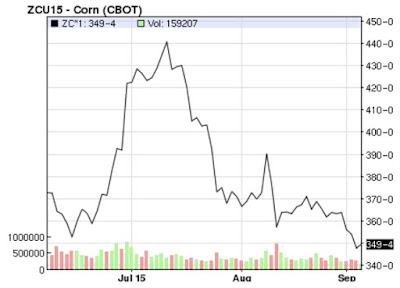
 

graph showing rise and steep fall in corn prices


Gloom is not the only thing that has been rolling across the landscape. Two parades really had to be seen to be appreciated. Each year since 1973, the state has hosted a bike ride across Iowa called Ragbrai. It is a weeklong activity that starts at the Missouri River to the west, and ends 500 miles to the east at the Mississippi River. It has grown into a massive affair that attracts some 15,000 riders.  

Image
roz iowa bike race


Photo Credit: C. Benz 

This year’s ride was special, at least for us. This mass of rolling humanity came within two miles of our farm, and it included a sizeable number of Stanford faculty and students (including my boss, pictured below) who, among others, made mini-detours to visit us. What were most interesting to my wife and me were the impressions expressed both by the bikers and the local hosts. 

The riders marveled at the rolling topography of Iowa; the vast expanses of corn and soybeans; the welcoming hospitality of Iowans; the infinite ways pork could be served on a stick; and the best sweet corn in the world! The locals were bemused that so many sane people of all shapes and sizes would voluntarily ride 500 miles in the heat and rain; amazed by the short-term chaos that 15,000 cyclists could cause in small rural communities that were attempting to move machinery and feed cattle; and pleased by the magnitude of the expenditures. The latter was deftly described by a neighbor as “our own economic stimulus package,” and more pointedly summarized by a local headline, “Circus, Economic Windfall, or Occupying Army?” 
 

Image
roz iowa bike race 2


 Photo Credit: R. Naylor

Politicians formed the second parade (charade?) that has been rolling across the state. Iowa—with the dubious honor of having the first primary/caucus—is a genuinely purple state. It voted for President Barack Obama in 2012 and for Senator Joni Ernst in 2014. Iowans pride themselves on being able to pick winners and on being stubbornly independent. The prevailing general mood at the moment, however, is some combination of confusion and disgust. Donald Trump draws the most comments. And while he leads the polls, I have yet to hear anyone (literally) this summer say that he or she favored him. Time will tell what Iowans really believe.


Nowhere was the comedy and chaos more vivid than at the recently completed Iowa State Fair. Some 15 presidential candidates showed up. Most of them spoke at the fair’s “Soapbox Corner” before conspicuously casting their kernel-of-corn vote at the straw (corn?) ballot table. They also had the obligatory pictures taken with the life-sized cow sculpted in butter, the fair’s largest bull (there must be some symbolism here), and the fair’s heaviest pig. The latter was a 500-pound specimen named Mac. (I was disappointed that an earlier winner, my namesake “Wally”, was not in the competition.) And to no one’s surprise, all candidates thought that corn-based ethanol was a really good idea. Most of them even expressed favor with the fair’s latest cuisine contribution—the Bomb—brisket, wrapped in bacon, served on a stick! 
 

Image
wally cafe outside


Photo Credit: R. Naylor 

Readers of previous reports will be pleased to know that the 1868 Waubeek general store and restaurant still serves as the morning gathering place. It has changed hands, but continues its long tradition of watery coffee and stale pastry. (By request, I have included pictures; I am California hatless, plus a shot of the outside.) Besides prices, bikers, and politicians, three new topics of conversation have cropped up: water, cover crops, and weeds. All three are environmental issues that are distinctly operational. They also remind me of just how much information is exchanged around tables such as this one, though on any given morning that conclusion is not always obvious!

 
Image
wally cafe
Photo Credit: R. Naylor 


By far the most controversial topic of the summer has been water. (And to be clear, the issue is about water quality and the nutrients carried in the water, not about water supplies or allocations.) Many farmers realize that nutrient runoff from livestock operations and from fertilizer applied to fields is a very serious problem; most of them are also loathsome about EPA efforts to redefine and regulate what constitutes water flows in the U. S. 

During the last week in August, the EPA announced new clean-water rules that would give the agency new jurisdiction over bodies of water (and land), including many in agriculture, which were previously unregulated. But it remains to be seen which bodies of waters would be covered, and which specific agricultural situations that would be exempted from the rules. Six states have sued the EPA, and the question of when or if the rules will be implemented is now caught up in the courts. The Farm Bureau has declared an all-out offensive against the rules, and farm publications have added further fuel to the fire. To complicate matters even more, the Des Moines Water Works has brought suit against three counties upstream of its water plant that would require farmers to change practices and/or make investments to reduce nutrient flows (particularly nitrates) into the Raccoon River. 

Most scientists and many farmers believe that nutrient runoff constitutes the largest remaining environmental problem facing agriculture. Thus the fight, in many ways, is less about the problem, and more about philosophy. Most farmers prefer voluntary solutions arranged with the state or the USDA. They typically dislike mandatory rules of any sort, and they are particularly concerned that regulations might be of the one-size-fits-all character. The discourse is inflamed by uncertainty: the EPA has yet to write all of the regulations, and farmers simply do not know what to expect. In the absence of information, they fear the worst. Everyone I talked with had a relevant question. Will we need to get a permit to spread manure? How will drainage tiles that empty into or near creeks be handled? Will we need to file a nitrogen plan for every farm that specifies amounts and timing of fertilizer applications? On our farm, for example, we have a flowing creek that traverses a large permanent pasture. The creek provides water for the cowherd, which has direct access to it. What, if anything, will need to be changed in that arrangement? All of us wonder about the flexibility in timing and scope that will be accorded farmers who may be faced with large corrective investments. Many also fear that the regulators will know little about agricultural practices. In short, what waters are to be regulated, for what purposes, and with what instruments are issues still to be resolved? At the moment, there is considerable heat, but very little light about the answers. 

Virtually all Iowa farmers have transitioned to minimum tillage systems; plowing has become a field operation of the past. This change in tillage also creates new cropping opportunities. 
 

Image
tillage radish usda


Photo Credit: USDA


Five years ago, there was virtually no talk about or use of “cover crops.” These crops are sown in residues immediately after corn or soybean harvest. Certain of them survive the winter, but others do not. Radishes (shades of the English agricultural revolution, circa 1700!) produce long roots that punch holes in clay layers of the soil, thereby assisting drainage. They can also be grazed. Small grains are also being seeded, which add to add organic matter and can sometimes be chopped as forage for dairy or beef operations. 
 

Image
triticale

Photo Credit: Mühlhausen/landpixel


Cover crops are clearly still a work in progress, but they provide an interesting example of active on-farm experimentation. Best solutions seem to vary from farm to farm—from no cover, to radishes, to triticale—and seem importantly dependent on particular crop-livestock combinations. Discussions about the use of triticale—a cross between rye and either bread wheat or durum—were of particular interest to me. I worked with Norman Borlaug at the International Wheat and Maize Improvement Center in Mexico during the 1980s to develop modern varieties of this crop, but it has been slow to find appropriate niches in cropping systems around the world. In the 1980s, I never even contemplated that Iowa might be such a place. 

Several forces drive the new concern about weeds. Falling crop prices have squeezed profit margins severely, causing farmers to look seriously at each cost component. For the first time, I have heard farmers question new seed varieties (virtually all GMOs), both because of their cost and their effectiveness. They increasingly wonder if the $200 seed-cost-per-acre for corn is justified. The current year, with its excellent growing season, meant there was less need for certain stacked traits such as drought resistance. Moreover, the year was equally good for weeds, whose resistance to major herbicides like Roundup seemed to be spreading. 

Water hemp, in particular, gave soybean farmers grief, and is causing them to rethink seed-weed strategies. They worry about the consequences from applying new combination-herbicides (some still under various reviews) that attack both grasses and broad-leafed weeds. They are particularly concerned that spraying some of the new products will also destroy the grasses in waterways left specifically to prevent water erosion. 

My conjecture is that most farmers will still use the specialized seeds next year. I predict, however, that they will also be searching more carefully for lower-cost ways—both via seeds and herbicides—to manage weeds. The growing weed resistance problem has begun to scare them—a recent Greenwire Poll indicates that 90% are worried—and has belatedly driven home the difficulties that arise from overuse of only one or two herbicides. 


Image
cow calf


No Iowa report is complete without some cattle commentary. 

My father was a cattle feeder, and some of those “cattle genes” carried forward a generation. I grew up knowing a lot about purebreds, about corn and soybean-meal feed rations, and about 2-pound-per-day rates of gain that produced 1100-pound animals for sale. Fast forward to 2015. When I look around, virtually all cattle have been crossbred for size and vigor (though in the market they may still be advertised as Angus!). Soybean meal has dropped completely out of the rations being fed in our county, having been replaced by the high-protein distillers grain, the by-product of making corn sweeteners and ethanol. Rates of gain are now 3.25 pounds per day, and finished animals are sold at 1500 pounds. What has not changed, however, is the riskiness of the enterprise. Even with cheap corn, buying 700 pound feeders for $2.25 per pound, and selling 1500 pound steers at $1.45 per pound has not been a great way to get rich in 2015! 

My final impression of the summer is a memorable one: rolling down the Mississippi River on a paddle boat, celebrating my wife’s and my birthdays with good friends, viewing a glorious sunset, and eating world-class prime rib. Now that’s the way to get ready for a new year of Stanford classes.

 
Image
3945950681 f49098fb76 o


Photo credit: flickr/Lance and Erin

Hero Image
roz iowa bike race 2
All News button
1
News Type
News
Date
Paragraphs


In a new study in the journal BioScience, a team of researchers including Stanford professor Roz Naylor links marijuana cultivation to widespread environmental damage in California and calls for greater regulation of the crop’s impact on natural ecosystems.

Recent debates about marijuana legalization have focused on the potential social, health and economic impacts, with little attention paid to environmental issues. The new study, spearheaded by the California chapter of The Nature Conservancy, brings environmental concerns to the forefront of the policy discussion. Between 60 and 70 percent of the marijuana consumed in the United States comes from California.
 

Water and wildlife

Marijuana plants require nearly twice as much water as do grapes or tomatoes, and the last five years have brought a 50 to 100 percent increase in the amount of northern California watershed lands used for marijuana production – figures that are causing growing concern among conservationists in the midst of a severe statewide drought.

The majority of California agriculture is subject to heavy water use regulations. Farmers of most irrigated crops help their plants through the dry summer months by filling water tanks in the winter, when streams and springs are full.

By contrast, many marijuana growers draw surface water during the plant’s summer growing season, when drought conditions are worst.

“Taking water directly from rivers and streams in the summer not only reduces the water available for agriculture but also threatens wildlife species, especially birds and fish, that depend on these wetland ecosystems for survival,” said Naylor.

Illegal marijuana plantations in California are associated with a wide range of other environmental impacts, including pollution, poaching, and pesticides that poison wildlife. Even legal outdoor cultivation can cause deforestation and soil erosion.
 

Policy options

The research team identified several opportunities to reduce the environmental impacts of marijuana cultivation in California. For example, states can:

  • Offer incentives for growers to protect natural resources
  • Enforce new or existing environmental laws,
  • Use sales tax revenues to fund restoration projects
  • Implement certification or labeling programs to encourage consumers to buy sustainably grown products.

“Regardless of the legal status of marijuana, the way we are currently managing its impacts on water and wildlife in California just doesn’t work,” said Naylor. “Bringing these impacts into future policy discussions about marijuana is critical for protecting California’s environmental resources given the high value and demand for the crop.”

Naylor is William Wrigley Professor of Earth Science at Stanford, director of the Center on Food Security and the Environment, and a senior fellow at the Stanford Woods Institute for the Environment and the Freeman Spogli Institute for International Studies. She serves as a trustee of The Nature Conservancy California Chapter.


Media Contact

Laura Seaman, Communications Manager, Center on Food Security and the Environment: lseaman@stanford.edu 
Lisa Park, Media Relations, The Nature Conservancy: lpark@tnc.org.

Hero Image
adobestock 61241553 Svetlana Nikolaeva
All News button
1
Paragraphs

The liberalization of marijuana policies, including the legalization of medical and recreational marijuana, is sweeping the United States and other countries. Marijuana cultivation can have significant negative collateral effects on the environment that are often unknown or overlooked. Focusing on the state of California, where by some estimates 60%–70% of the marijuana consumed in the United States is grown, we argue that (a) the environmental harm caused by marijuana cultivation merits a direct policy response, (b) current approaches to governing the environmental effects are inadequate, and (c) neglecting discussion of the environmental impacts of cultivation when shaping future marijuana use and possession policies represents a missed opportunity to reduce, regulate, and mitigate environmental harm.

All Publications button
1
Publication Type
Journal Articles
Publication Date
Journal Publisher
Bioscience
Authors
Rosamond L. Naylor
Number
8
News Type
News
Date
Paragraphs

FSE director Roz Naylor has been selected to deliver the 6th annual Ned Ames Honorary Lecture at the Cary Institute of Ecosystem Studies in Millbrook, NY on Friday, April 24. Her lecture on "Feeding the World in the 21st Century," is free and open to the public, and a video recording of the event will be available on the Cary Institute's website shortly after the talk.

Hero Image
roz high res 9 11
All News button
1
-

Image
ctd banner2015v2

For more information and to register, visit tomkat.stanford.edu/ctd.

Each year Stanford experts from a range of disciplines meet to discuss the interconnections and interactions among humanity's needs for and use of food, energy, water and the effect they have on climate and conflict.  These experts will illustrate and evaluate some of the ways in which decisions in one resource area can lead to trade-offs or co-benefits in others, and discuss opportunities to make decisions that can have positive benefits in one area while avoiding negative or unintended consequences in other areas.  This year, in celebration of our 5th anniversary of Connecting the Dots, we return to the food nexus. 
 

Confirmed Speakers

  • Keynote Speaker: Karen Ross, Secretary of California Department of Food and Agriculture
  • Professor Stacey Bent, TomKat Center for Sustainable Energy, Precourt Institute for Energy, Chemical Engineering
  • Professor Roz Naylor, Center on Food Security and the Environment, Environmental Earth System Science, Stanford Woods Institute for the Environment, Freeman Spogli Institute for International Studies
  • Professor David Lobell, Center on Food Security and the Environment, Environmental Earth System Science, Freeman Spogli Institute for International Studies, Stanford Woods Institute for the Environment 
  • Professor Marshall Burke (food - conflict nexus), Environmental Earth System Science, Center on Food Security and the Environment
  • Professor Steve Luby (food - health nexus), Stanford Medicine, Stanford Woods Institute for the Environment, Freeman Spogli Institue for International Studies
  • Professor Scott Rozelle (food, education and development nexus), Co-director, Rural Education Action Program, Freeman Spogli Institute for International Studies, Stanford Institute for Economic Policy Research, Center on Food Security and the Environment


Student-led Breakout Sessions

  • Christopher Seifert, Graduate Student, Environmental Earth System Science
    "Boondoggle or Risk Reducer? Crop insurance as the farm subsidy of the 21st century"
  • William Chapman, Graduate Student, CEE-Atmosphere and Energy
    "No Red Meat or a New Electric Vehicle, Food Choices and Emissions"
  • Priya Fielding-Singh, PhD Candidate, Sociology
    Maria Deloso, Coterminal B.S/M.A. Candidate, Environmental Earth System Science  
    "From Farm to Lunch Tray: Toward a Healthy and Sustainable Federal School Lunch Program"
  • Rebecca Gilsdorf, PhD Candidate, Civil & Environmental Engineering
    Angela Harris, PhD Candidate, Civil & Environmental Engineering
    "Poop and Pesticides: Looking beyond production to consider food contamination"
Event Poster
Download pdf

Frances C. Arrillaga Alumni Center
326 Galvez Street
Stanford University

MAP

Conferences
-

Crowne Plaza Hotel Harbour City
Shanghai, China

The Jerry Yang and Akiko Yamazaki
Environment and Energy Building
Stanford University
473 Via Ortega, Office 363
Stanford, CA 94305

(650) 723-5697 (650) 725-1992
0
Senior Fellow, Stanford Woods Institute and Freeman Spogli Institute for International Studies
William Wrigley Professor of Earth System Science
Senior Fellow and Founding Director, Center on Food Security and the Environment
Roz_low_res_9_11_cropped.jpg PhD

Rosamond Naylor is the William Wrigley Professor in Earth System Science, a Senior Fellow at Stanford Woods Institute and the Freeman Spogli Institute for International Studies, the founding Director at the Center on Food Security and the Environment, and Professor of Economics (by courtesy) at Stanford University. She received her B.A. in Economics and Environmental Studies from the University of Colorado, her M.Sc. in Economics from the London School of Economics, and her Ph.D. in applied economics from Stanford University. Her research focuses on policies and practices to improve global food security and protect the environment on land and at sea. She works with her students in many locations around the world. She has been involved in many field-level research projects around the world and has published widely on issues related to intensive crop production, aquaculture and livestock systems, biofuels, climate change, food price volatility, and food policy analysis. In addition to her many peer-reviewed papers, Naylor has published two books on her work: The Evolving Sphere of Food Security (Naylor, ed., 2014), and The Tropical Oil Crops Revolution: Food, Farmers, Fuels, and Forests (Byerlee, Falcon, and Naylor, 2017).

She is a Fellow of the Ecological Society of America, a Pew Marine Fellow, a Leopold Leadership Fellow, a Fellow of the Beijer Institute for Ecological Economics, a member of Sigma Xi, and the co-Chair of the Blue Food Assessment. Naylor serves as the President of the Board of Directors for Aspen Global Change Institute, is a member of the Scientific Advisory Committee for Oceana and is a member of the Forest Advisory Panel for Cargill. At Stanford, Naylor teaches courses on the World Food Economy, Human-Environment Interactions, and Food and Security. 

CV
Co-chair
0
Ling_Cao.jpg PhD

Ling Cao completed her Ph.D. in Natural Resources and Environment at the University of Michigan, Ann Arbor. Trained as an agronomist and environmental scientist, she has focused on interdisciplinary research at the interface between the sustainability of food and natural systems. Her dissertation research quantitatively assessed the sustainability of emerging shrimp farming systems and technologies, and in particular focused on applying these results to producers and consumers in China and US. In early 2018, Cao was selected as a recipient of the “National Thousand Talents Program for Distinguished Young Scholars,” an initiative of the Chinese government to attract high-level talent from overseas to work full-time in China. In addition, she was also selected as a fellow of the “Shanghai Thousand Talents Program” which aims to recruit top-talent who are leaders in their fields to help enhance Shanghai's future development and sustainable competitiveness. Cao currently works as an associate professor in the Institute of Oceanography at Shanghai Jiao Tung University and continues to work with Roz Naylor and colleagues on fisheries and aquaculture research.

Co-chair
Symposiums
Subscribe to Water