
 FSI researchers consider international development from a variety of angles. They analyze ideas such as how public action and good governance are cornerstones of economic prosperity in Mexico and how investments in high school education will improve China’s economy.
They are looking at novel technological interventions to improve rural livelihoods, like the development implications of solar power-generated crop growing in Northern Benin.
FSI academics also assess which political processes yield better access to public services, particularly in developing countries. With a focus on health care, researchers have studied the political incentives to embrace UNICEF’s child survival efforts and how a well-run anti-alcohol policy in Russia affected mortality rates.
FSI’s work on international development also includes training the next generation of leaders through pre- and post-doctoral fellowships as well as the Draper Hills Summer Fellows Program.
A Global Perspective on Food Policy
News Type
Commentary
Date
Paragraphs
Read the original post on Medium.com:
A Global Perspective on Food Policy
I applaud Mark Bittman, Michael Pollan, Ricardo Salvador, and Olivier de Schutter for advocating the introduction of a national food policy in the U.S. Greater emphasis in our current farm legislation on nutrition, health, equity, and the environment is clearly warranted and long overdue. As the authors note, Americans’ access to adequate nutrition at all income levels affects educational and health outcomes for the nation as a whole. Poor nutrition thus plays a role in determining the level and distribution of economic and social wellbeing in the U.S, now and in the future. It is surprising that no one within the large circle of Presidential hopefuls has raised the topic of food, not just agriculture, as a major political issue for the 2016 election.
The U.S. is not unique. Virtually every country with an agrarian base has, at some point in history, introduced agricultural policies that support farmers and provide incentives for them to produce major commodities. At the time, governments have been able to justify these policies on several grounds: national security (avoiding excess dependence on foreign nations for food), economic growth (using agricultural surpluses as an engine of economic growth), and social stability (keeping its population well-fed to avoid social unrest). Once agricultural policies are implemented, they typically give rise to institutions and vested political interests that perpetuate a supply-side orientation to food and agriculture. In the U.S., the political institutions that govern food and agriculture have their roots in historical political precedents that date back to the 1860s, and later to the 1930s when the New Deal was promulgated. Farm interests have been entrenched in the U.S. political system for quite some time, and they cannot be easily removed.
There is a general rule for successful policies: Align incentives with objectives. A corollary to this principle is that objectives change over the course of economic development. For the United States in earlier eras, and for many developing economies in recent decades, meeting basic calorie needs has been the first order of business. This objective has been largely achieved through public investments in infrastructure (irrigation, roads), research and development, commodity support programs, incentives for private agribusiness development, and other supply-side measures.
With successful agricultural growth and rising incomes, many countries face a new set of food and nutrition challenges: eliminating “hidden hunger” (deficiencies in iron, vitamin A, calcium, zinc and other micronutrients), and abating the steady rise in obesity that results from a transition to diets rich in energy-dense carbohydrates, fats, and sugar. Hidden hunger affects some three billion people worldwide. It is prevalent among low-income households in almost all countries, impairs cognitive and physical development (especially among infants up to two years of age) and thus limits a nation’s educational and economic potential. Meanwhile, rates of obesity now surpass rates of energy-deficient hunger throughout the world, even in developing nations.
The objectives of food and agricultural policies in virtually all countries need to shift, on balance, from promoting staple food supplies to enhancing nutrition. I am not suggesting an abandonment of agriculture, but rather an enrichment of agriculture with more crop diversity to support the nutritional needs of all people. If improved nutrition is the objective, what are the correct incentives? Proper incentives will differ among countries, but will inevitably require a fundamental change in institutional structure. With a shift from supply- to demand orientation, there needs to be a transition from Ministries of Agriculture to Ministries of Food. After all, the main goals of a Ministry of Agriculture are to increase the volume of agricultural production and to improve economic growth in the agricultural sector. The main goal of a Ministry of Food, by contrast, is to enhance the nutrition and food security of the entire population.
Bittman, Pollan, Salvador, and de Schutter emphasize that replacing the U.S. Department of Agriculture (USDA) with a “U.S. Department of Food, Health, and Wellbeing” would be difficult at best. It would require unprecedented political will and cooperation among parties. The same can be said for institutional change in agricultural ministries throughout the world. Regardless of the challenges, however, nothing will change until the conversation surrounding food policies, politics, and institutions takes a major turn.
Hero Image

All News button
1
Achieving food security and nutrition for the furthest behind in an era of conflict and climate change
-
Image

Cousin brings more than twenty-five years of national and international non- profit, government, and corporate leadership experience focusing on hunger, food, and resilience strategies. Cousin guides WFP in meeting urgent food needs while championing longer-term solutions to food insecurity and hunger.
As the leader of the world’s largest humanitarian organization with 14,000 staff serving 80 million beneficiaries in 75 countries, she is an exceptional advocate for improving the lives of hungry people worldwide, and travels extensively to raise awareness of food insecurity and chronic malnutrition.
In 2009, Cousin was confirmed as the U.S. Ambassador to the UN Agencies for Food and Agriculture in Rome.
Previously, Cousin served as White House Liaison to the State Department, during which time she was appointed to the Board for International Food and Agricultural Development, and Executive Vice President and Chief Operating Officer of Feeding America.
A Chicago native, Cousin is a graduate of the University of Illinois at Chicago and the University of Georgia Law School.
Ertharin Cousin
Executive Director, United Nations World Food Programme
Symposiums
Poverty Alleviation through Sustainable Palm Oil Production
This project focuses on private and public sector strategies for promoting sustainable palm oil, with sustainability defined by environmental, social, and economic objectives. The main goals are:
Drought increases the spread of HIV in Africa
News Type
News
Date
Paragraphs
Bad weather in sub-Saharan Africa increases the spread of HIV, according to a study published in the June 2015 issue of the Economic Journal, co-authored by Stanford professor and FSE fellow Marshall Burke.
When the rains fail, farmers in rural areas often see their incomes fall dramatically and will try to make up for it however they can, including through sex work. Analysing data on more than 200,000 individuals across 19 African countries, the research team finds that by changing sexual behaviour, a year of very low rainfall can increase local infection rates by more than 10%.
The results have important policy implications for fighting the spread of the epidemic, as co-author Erick Gong of Middlebury College notes:
‘Existing approaches to stopping the spread of HIV – such as promoting condom use and the use of anti-retrovirals – remain critically important. But our results suggest that other policy approaches could be very useful too – in particular, approaches that provide safety nets to rural households when the weather turns bad.’
Policies and investments seemingly unrelated to HIV – such as the promotion of rural insurance or household savings schemes, or the development of drought-tolerant crops – might have surprising benefits in slowing the HIV epidemic. Co-author Kelly Jones of the International Food Policy Research Institute says:
‘The HIV/AIDS epidemic remains one of the world’s greatest health challenges, with over a million new infections per year in Africa alone. Our results expand the menu of options for addressing the epidemic, and highlight some surprising options that are not at the forefront of people’s minds.’
The research sheds valuable light on why HIV continues to spread in Africa. Previous studies have documented in limited settings that poor women often alter their sexual behaviour in response to an income shortfall. But until now, there has been little evidence that this response is big enough to affect the trajectory of the HIV epidemic.
To fill this gap, the researchers combined data on the HIV status of thousands of people across sub-Saharan Africa with data on the recent rainfall history in each individual’s location.
Because years of low rainfall can lead to much lower incomes in these locations, particularly in rural areas where people depend more heavily on agriculture for their livelihoods, variation in rainfall provides a way to study how changes in local economic conditions affect infection rates. Co-author Marshall Burke comments:
‘We were surprised by how strong the relationship is between recent rainfall fluctuations and local infection rates. As expected, the relationship is much stronger in rural areas, and particularly for women who report working in agriculture. These are the people who really suffer when the rains fail, and who are forced to turn to more desperate measures to make ends meet.’
Notes for editors: ‘Income Shocks and HIV in Africa’ by Marshall Burke, Erick Gong and Kelly Jones is published in the June 2015 issue of the Economic Journal.
Marshall Burke is an assistant professor of Earth System Science at Stanford University. Erick Gong is an assistant professor of economics at Middlebury College. Kelly Jones is a research fellow at the International Food Policy Research Institute (IFPRI).
For further information: contact Marshall Burke on +1-650-736-8571 (email: mburke@stanford.edu); Erick Gong on +1-802-443-5553 (email: egong@middlebury.edu); Kelly Jones on +1-202-862-4641 (email: k.jones@cgiar.org); or Romesh Vaitilingam on +44-7768-661095 (email: romesh@vaitilingam.com; Twitter: @econromesh).
Hero Image

All News button
1
"Doomsday vault" founder calls for seed saving, plant breeding to cope with climate change
News Type
News
Date
Paragraphs
Governments must do more to diversify the types of crops grown throughout the world. If they don’t, climate change may jeopardize the global food supply, a leading agriculture researcher told a Stanford audience.
Cary Fowler, a senior advisor and former executive director of the Global Crop Diversity Trust, was a driving force behind the creation of the Svalbard Global Seed Vault in Norway. Commonly known as the “doomsday vault,” the repository of ancient and modern seeds from around the world ensures that future generations will have access to a wide enough range of crop traits to adapt global agriculture to a changing climate.
 Dr. Cary Fowler in Svalbard, Norway, the home of the Svalbard Global Seed Vault.
During a May 6 talk sponsored by FSE as part of the center’s Food and Nutrition Policy Symposium, Fowler warned that increasingly high temperatures and water shortages interfere with the natural growing cycles of many crops and can even reduce the nutritional quality of some plants. Higher temperatures also give way to new pests, diseases, and soil microorganisms that threaten yields.
“The biggest impacts from climate change will be in sub-Saharan Africa,” Fowler said, a region where many people already suffer serious poverty and hunger, and where crop yields lag behind the rest of the world. Fowler said that as climate pressure on agriculture intensifies, the world can expect to see an uptick in civil conflict, restrictive trade policies, and suffering among the world’s poorest people.
“Crops are going to be facing new combinations of conditions for which there is no historical experience,” said Fowler. “They will require new combinations of traits” that can only be developed by preserving genetic diversity and proactively breeding new varieties.
“There are 1.3 billion people living on subsistence farms today,” said Dr. Cary Fowler to a Stanford audience on May 6. “How will they adapt to climate change without access to diversity?”
Fowler called for the U.S. and foreign governments to embrace their “inherited evolutionary responsibility” for preserving the huge diversity of crops grown by farmers throughout human history.
The United States is the ideal candidate to lead the world in using crop genetic diversity to adapt agriculture to climate challenges, he said. “The U.S. is well-positioned to research diversity, model future climate and assemble seed packages,” enlisting farmers in the U.S. and abroad in “another mass adaptation experiment” like the one American agriculture undertook in the 18th and 19th centuries.
“I know that sounds like a wild and crazy idea,” Fowler said. “But I haven’t heard any alternatives to it. If we’re assuming we’re going to have development without diversity, that would really be a historically unprecedented experiment.”
“If agriculture doesn’t adapt,” he added, “neither will we.”
A diverse history
In the late 1700s the United States food system lacked diversity and infrastructure. “Very few of the crops we grow now in the U.S. are native,” said Fowler. Early on, “it wasn’t always evident what crops from abroad would grow well in the U.S.”
The government soon set out to expand and diversify American agriculture. U.S. Navy ships collected seeds on overseas voyages, and U.S. diplomats brought back new crops from postings abroad. Government-sponsored expeditions sought out foreign plants with specific disease-resistant traits. The U.S. signed two dozen seed-exchange agreements with other countries, and lowered taxes on imported seeds to boost global crop exchange.
Image
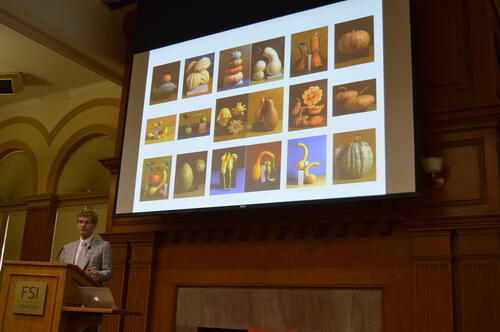
“The United States amassed a much more diverse array of seeds and crops as a result,” said Fowler. One program introduced 600 new apple varieties, 700 new types of pears, and 353 new varieties of mangoes to American farmers.
But the United States did not simply collect new crops. It also invested in research to develop new varieties, including through plant breeding.
Genetic erosion
Research into plant breeding quickly yielded many of the modern varieties of crops we grow today in the United States.
“With plant breeding came the rise of modern varieties that had useful traits like disease resistance,” said Fowler. A small handful of new varieties quickly gained popularity with American farmers, who now had a choice about whether or not to save seeds and grow many varieties of a crop at once. Most farmers chose not to, instead relying on the same few mainstream varieties their neighbors were growing.
This shift has led to what Fowler described as the “genetic erosion” of agriculture, a trend that can only be reversed by reviving the tradition of seed saving and plant breeding on a global scale.
Seed banks
“I have probably been to more seed banks than any other person,” said Fowler. Seeds from most crops can survive hundreds or even thousands of years in storage, but most storage facilities lack the physical security to provide lasting safe haven. Many seed banks are poorly built, too warm or humid for long-term storage, and vulnerable to natural disasters. Other facilities suffer damaged during civil wars and uprisings.
Even if banks are physically secure, said Fowler, most simply do not operate on a large enough scale to protect global crop diversity. “Most crops in the world have between one and 10 total seed samples in storage, and most have no plant breeders working on them at all,” said Fowler.
The doomsday vault
In 2005 Fowler was chosen to lead an international coalition to build the Svalbard Global Seed Vault. The Norwegian government owns the facility, and it is also managed by the Global Crop Diversity Trust and the Nordic Genetic Resource Center.
The vault is built into the side of a mountain in the far north of Norway, said Fowler, because the ideal temperature for storing seeds is minus 18 degrees Celsius.
Inside the frozen walls of the vault are shelves full of boxes holding duplicate seeds from smaller seed banks around the world. Foreign governments that contribute samples pay nothing for storage, and the seed packages are never opened by vault staff, said Fowler.
“The vault now houses seeds from over 864,000 varieties of plants,” said Fowler, adding that not a single sample has ever been lost.
 Seed storage boxes at the Svalbard Global Seed Vault.
The facility’s nickname, “the doomsday vault,” comes not only from its rugged physical location but from its capacity to withstand disasters – something its planners took great care to design. “We calculated how high the water would go if all ice in the world melted and we had the world’s largest ever tsunami,” said Fowler. “The vault is five stories above that.”
“Not a solution”
Fowler emphasized that no doomsday vault, no matter how secure its walls or how ample its seed collection, can solve the problem of crop genetic erosion. Building a vault “doesn’t mean that we as a society are getting serious about adapting agriculture to climate change,” Fowler said. Plant breeding and crop research programs focused on developing new climate-resilient varieties are just as crucial as saving seeds.
Although a few major staple crops like rice, wheat and corn are continually bred and improved in research labs around the world, most crops are largely ignored by researchers. For example, there are only six breeders of yams worldwide.
“Why conserve it if you’re not going to use it?” Fowler asked. “We are acting like crops are going to adapt by themselves, and we are assuming all but a handful of crops are unimportant.”
Quoting Charles Darwin, Fowler added that “it is not the strongest of the species that survives, nor the most intelligent, but the one most responsive to change.”
Full video and audio recordings of Dr. Fowler's May 6 lecture, and his interview with FSE director Roz Naylor, are available here.
Hero Image

All News button
1
The United States and Global Food Security: A View From Rome
-
Image

Ambassador David Lane was nominated by President Barack Obama to serve as the U.S. Representative to the United Nations Agencies for Food and Agriculture and confirmed by the U.S. Senate on May 24, 2012.
Ambassador Lane has more than twenty years of experience working in leadership positions across sectors. Before coming to Rome, he served at the White House as Assistant to the President and Counselor to the Chief of Staff.
Prior to joining the Obama Administration, he served as President and CEO of the ONE Campaign, a global advocacy organization focused on extreme poverty, development, and reform. Before that, as Director of Foundation Advocacy and the East Coast Office of the Bill & Melinda Gates Foundation, he helped lead that organization’s advocacy and public policy efforts.
During the Clinton Administration, he served as Executive Director of the National Economic Council at the White House and Chief of Staff to the U. S. Secretary of Commerce. He served as Vice-Chair of Transparency International USA, and he is a member of the Council on Foreign Relations
Ambassador Lane earned his B.A. from the University of Virginia and his M.P.A. from the Princeton University Woodrow Wilson School of Public and International Affairs.
Sponsored by the Center on Democracy, Development and the Rule of Law (CDDRL) and the Center on Food Security and the Environment (FSE). Supported in part by Zachary Nelson ('84) and Elizabeth Horn.
Ambassador David Lane, United States Representative to UN Agencies in Rome
United States Representative to UN Agencies in Rome
Speaker
Lectures
Connecting the Dots 2015: The Food, Energy, Water and Climate Nexus
-
Image

For more information and to register, visit tomkat.stanford.edu/ctd.
Each year Stanford experts from a range of disciplines meet to discuss the interconnections and interactions among humanity's needs for and use of food, energy, water and the effect they have on climate and conflict. These experts will illustrate and evaluate some of the ways in which decisions in one resource area can lead to trade-offs or co-benefits in others, and discuss opportunities to make decisions that can have positive benefits in one area while avoiding negative or unintended consequences in other areas. This year, in celebration of our 5th anniversary of Connecting the Dots, we return to the food nexus.
Confirmed Speakers
- Keynote Speaker: Karen Ross, Secretary of California Department of Food and Agriculture
- Professor Stacey Bent, TomKat Center for Sustainable Energy, Precourt Institute for Energy, Chemical Engineering
- Professor Roz Naylor, Center on Food Security and the Environment, Environmental Earth System Science, Stanford Woods Institute for the Environment, Freeman Spogli Institute for International Studies
- Professor David Lobell, Center on Food Security and the Environment, Environmental Earth System Science, Freeman Spogli Institute for International Studies, Stanford Woods Institute for the Environment
- Professor Marshall Burke (food - conflict nexus), Environmental Earth System Science, Center on Food Security and the Environment
- Professor Steve Luby (food - health nexus), Stanford Medicine, Stanford Woods Institute for the Environment, Freeman Spogli Institue for International Studies
- Professor Scott Rozelle (food, education and development nexus), Co-director, Rural Education Action Program, Freeman Spogli Institute for International Studies, Stanford Institute for Economic Policy Research, Center on Food Security and the Environment
Student-led Breakout Sessions
- Christopher Seifert, Graduate Student, Environmental Earth System Science
"Boondoggle or Risk Reducer? Crop insurance as the farm subsidy of the 21st century" - William Chapman, Graduate Student, CEE-Atmosphere and Energy
"No Red Meat or a New Electric Vehicle, Food Choices and Emissions" - Priya Fielding-Singh, PhD Candidate, Sociology
Maria Deloso, Coterminal B.S/M.A. Candidate, Environmental Earth System Science
"From Farm to Lunch Tray: Toward a Healthy and Sustainable Federal School Lunch Program" - Rebecca Gilsdorf, PhD Candidate, Civil & Environmental Engineering
Angela Harris, PhD Candidate, Civil & Environmental Engineering
"Poop and Pesticides: Looking beyond production to consider food contamination"
Event Poster
Download pdf
Frances C. Arrillaga Alumni Center
326 Galvez Street
Stanford University
Conferences
Doomsday Vaults, Genebanks and Plant Breeding in the Age of Climate Change
-
Read a full event summary here.
Agricultural crops are on the front lines of climate change. Can we expect increased food production in the context of global warming? Do our crops come pre-adapted to a climate not seen since the dawn of agriculture, or must we take bold measures to prepare agriculture for climate change? This talk will focus on the role that crop diversity must necessarily play in facilitating the adaptation of agricultural crops to new climates and environments. Genebanks, the “Doomsday Vault” near the North Pole, and possible new roles for plant breeders and farmers will be explored.
Image

Dr. Cary Fowler is perhaps best known as the “father” of the Svalbard Global Seed Vault, which UN Secretary General Ban Ki-Moon has described as an “inspirational symbol of peace and food security for the entire humanity.” Dr. Fowler proposed creation of this Arctic facility to Norway and headed the international committee that developed the plan for its establishment by Norway. The Seed Vault provides ultimate security for more than 850,000 unique crop varieties, the raw material for all future plant breeding and crop improvement efforts. He currently chairs the International Council that oversees its operations.
In 2005 Dr. Fowler was chosen to lead the new Global Crop Diversity Trust, an international organization cosponsored by Food and Agriculture Organization of the UN (FAO) and the Consultative Group on International Agricultural Research (CGIAR). This position carried international diplomatic status. During his tenure, he built an endowment of $130 million and raised an additional $100 million (including the first major grant given for agriculture by the Gates Foundation) for programs to conserve crop diversity and make it available for plant breeding. The Trust organized a huge global project to rescue 90,000 threatened crop varieties in developing countries – the largest such effort in history - and is now engaged in an effort Dr. Fowler initiated with the Royal Botanic Gardens (Kew) to collect, conserve and pre-breed the wild relatives of 26 major crops. He oversaw development of a global information system to aid plant breeders and researchers find appropriate genetic materials from genebanks around the world. These initiatives at the Crop Trust, positioned the organization as a major path-breaking player in the global effort to adapt crops to climate change.
Prior to leading the Global Crop Diversity Trust, Dr. Fowler was Professor at the Norwegian University of Life Sciences in Ås Norway. He headed research and the Ph.D. program at the Department of International Environment and Development Studies and was a member of the university committee that allocated research funding to the different departments.
The U.N.’s FAO recruited him in the 1990s to lead the team to produce the UN’s first global assessment of the State of the World’s Plant Genetic Resources. He was personally responsible for drafting and negotiating the first FAO Global Plan of Action on the Conservation and Sustainable Utilization of Plant Genetic Resources, formally adopted by 150 countries in 1996. Following this, Dr. Fowler served as Special Assistant to the Secretary General of the World Food Summit (twice) and represented the Consultative Group on International Agricultural Research (CGIAR/World Bank) in negotiations on the International Treaty on Plant Genetic Resources. He chaired a series of Nordic government sponsored informal meetings of 15 countries to facilitate negotiations for this treaty. And, he represented Norway on the Panel of Experts of the Convention on Biological Diversity.
Cary Fowler was born in 1949 and grew up in in Memphis, Tennessee, the son of a judge and a dietician. He studied at Simon Fraser University in Canada where he received a B.A. (honors – first class) degree. He earned his Ph.D. at Uppsala University in Sweden with a thesis on agricultural biodiversity and intellectual property rights. Dr. Fowler has lectured widely, been a visiting scholar at Stanford University and a visiting professor at the University of California – Davis. He is the author or co-author of more than 100 articles and several books including the classic Shattering: Food, Politics and the Loss of Genetic Diversity (University of Arizona Press), Unnatural Selection, Technology, Politics and Plant Evolution (Gordon & Breach Science Publishers) and The State of the World’s Plant Genetic Resources (UN-FAO).
Dr. Fowler currently serves on the boards of Rhodes College, the NY Botanical Garden Corporation, the Lillian Goldman Charitable Trust and Amy Goldman Charitable Trust. He remains associated with the Global Crop Diversity Trust as Special Advisor. He is a former member of the U.S. National Plant Genetic Resources Board (appointed by the Secretary of Agriculture) and former board and executive committee member of the International Maize and Wheat Improvement Center in Mexico. He has served as chair of the national Livestock Conservancy. He is the recipient of several awards: Right Livelihood Award, Vavilov Medal, the Heinz Award, Bette Midler’s Wind Beneath My Wings Award, the William Brown Award of the Missouri Botanical Garden and two honorary doctorates. He is one of two foreign elected members of the Russian Academy of Agricultural Sciences and is a member of the Russian Academy of Sciences.
Dr. Cary Fowler
Speaker
Senior Advisor, Global Crop Diversity Trust
Symposiums